Guides
How to measure AI share of voice
Measure AI share of voice with a fixed set of prompts, engines, brands, and counting rules, then track the same metric over time.
AI share of voice tells you how often a brand appears relative to selected competitors in a defined set of AI answers.
A simple calculation is:
AI share of voice =
brand mentions ÷ mentions of all tracked brands × 100
For example, if your brand receives 40 mentions and all tracked brands receive 100 mentions in total, your AI share of voice is 40%.
The useful part is not the percentage alone. You also need to know which prompts, AI engines, competitors, and responses produced it.
Start with the buyer questions you want to track
Choose the prompts before collecting the answers.
For example, a CRM company might track:
- What are the best CRMs for small businesses?
- Which CRM is best for a growing sales team?
- What are good alternatives to Salesforce?
- Which CRM has the best reporting features?
- What CRM should a startup use?
These should represent real buyer questions that matter to the business.
Five to ten prompts can be enough for an initial snapshot. Use more when you need broader coverage, but do not add generic questions just to make the sample larger.
Record the exact wording so you can run the same questions again later.
Run the same prompts across the AI engines you want to measure
Choose the AI engines that matter for the report and run the same prompt set on each one.
For example:
| Prompt | ChatGPT | Claude | Gemini |
|---|---|---|---|
| Best CRM for small businesses | Run | Run | Run |
| Best CRM for growing sales teams | Run | Run | Run |
| Salesforce alternatives | Run | Run | Run |
| Best CRM reporting tools | Run | Run | Run |
Record the run date as well.
AI answers can change, so a share-of-voice result should always be tied to when the responses were collected.
If a prompt or engine fails, record the missing response instead of treating it as a brand absence.
Choose the brands you want to compare
Define the brand set before counting mentions.
For example:
Northstar CRM
Orbit CRM
Ledgerly
Include your brand and the competitors that matter for the category or buyer questions you are measuring.
Keep the same competitor set when you want to compare results over time.
If you add or remove a competitor later, record the change because it affects the calculation.
Count each brand once per response
For a simple AI share-of-voice measurement, count a brand once when it is clearly named in a response.
If the same brand appears three times in one answer, it still contributes one mention for that response.
For example:
| Response | Brands mentioned |
|---|---|
| Prompt 1, ChatGPT | Northstar CRM, Orbit CRM |
| Prompt 2, ChatGPT | Northstar CRM |
| Prompt 3, ChatGPT | Ledgerly |
| Prompt 4, ChatGPT | Orbit CRM, Ledgerly |
| Prompt 1, Claude | Northstar CRM |
| Prompt 2, Claude | Orbit CRM |
| Prompt 3, Claude | Ledgerly |
| Prompt 4, Claude | None |
That produces:
- Northstar CRM: 3 mentions
- Orbit CRM: 3 mentions
- Ledgerly: 3 mentions
- Total: 9 mentions
A response can count for more than one brand.
Count brands that are actually named in the answer rather than inferring a mention from a vague description.
Calculate AI share of voice
Once you have the mention counts, calculate each brand's share:
AI share of voice =
brand mentions ÷ total mentions of tracked brands × 100
For example:
| Brand | Mentions | AI share of voice |
|---|---|---|
| Northstar CRM | 4 | 40% |
| Orbit CRM | 3 | 30% |
| Ledgerly | 3 | 30% |
| Total | 10 | 100% |
Northstar CRM has a 40% AI share of voice because it received 4 of the 10 tracked brand mentions.
That does not mean Northstar has 40% market share. It means Northstar received 40% of the tracked mentions in the AI answers included in this measurement.
Keep the counts beside the percentage. A 50% share based on two mentions is very different from a 50% share based on one hundred.
Break the result down by prompt
The overall percentage gives you a useful headline, but it can hide where the visibility comes from.
Look at the prompt-level results too.
| Prompt | Northstar | Orbit | Ledgerly |
|---|---|---|---|
| Best CRM for small businesses | Yes | Yes | No |
| Best CRM for sales teams | Yes | No | Yes |
| Salesforce alternatives | No | Yes | Yes |
| Best CRM reporting tools | Yes | Yes | No |
A brand can have a reasonable overall share while being absent from an important buyer question.
That is often where the useful work starts.
If your brand rarely appears for one high-value prompt, look at the content that should establish why the product belongs in that answer.
Compare AI share of voice over time
Repeat the same measurement to see whether visibility is changing.
For example:
| Brand | May | June | July |
|---|---|---|---|
| Northstar CRM | 24% | 29% | 35% |
| Orbit CRM | 41% | 38% | 34% |
| Ledgerly | 35% | 33% | 31% |
If you kept the prompts, AI engines, competitors, and counting rule consistent, you can compare the snapshots.
Then look at the prompts behind the movement.
A brand may gain share because it started appearing for two important comparison questions while visibility elsewhere stayed flat.
That tells you more than the headline percentage alone.
Track AI share of voice with Maverank
You can calculate AI share of voice manually with a spreadsheet and a fixed prompt set.
For ongoing tracking, Maverank runs the prompts you want to monitor across ChatGPT, Claude, Gemini, and Google AI and shows how your brand compares with the competitors you track.
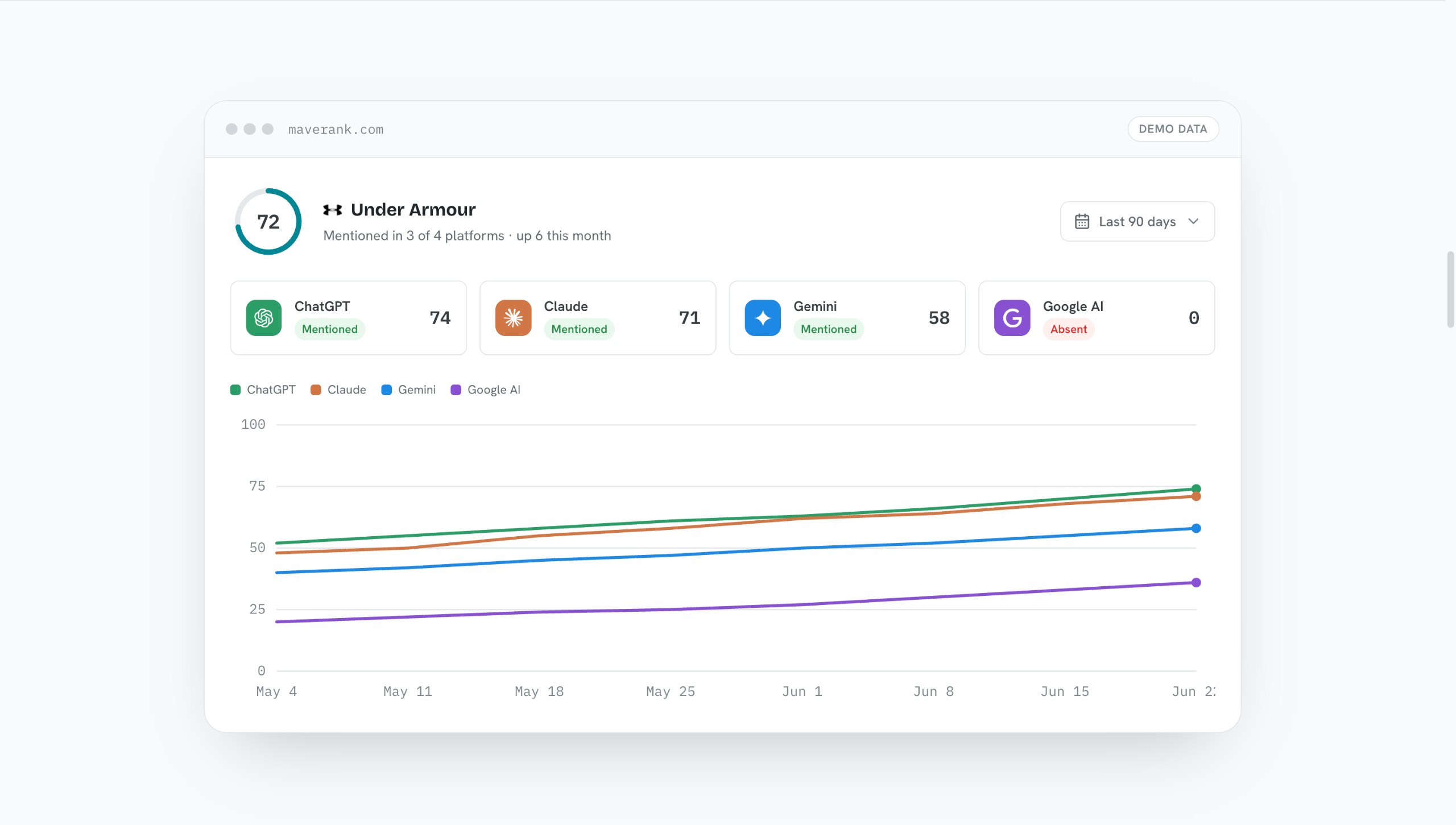
Maverank tracks AI visibility and share of voice across multiple AI platforms over time.
You can use Maverank to review:
- share of voice against competitors
- visibility by AI platform
- which prompts mention your brand
- how visibility changes over time
- competitor mentions and positioning
That removes the manual work of rerunning the same prompt set and recounting mentions every reporting period.
The underlying answers still matter. When share of voice moves, look at the prompts and responses behind the change to understand where visibility was gained or lost.
Look at the pages behind weak visibility
Share of voice tells you where your brand appears and where it does not.
If the brand is missing from an important buyer question, review whether your site clearly explains:
- what the product does
- who it is for
- important use cases
- comparisons and alternatives
- pricing and packaging
- technical capabilities
- evidence that supports the claims you want AI systems to understand
Also check whether AI systems can access and interpret those pages.
This gives you a practical loop:
- Find prompts where your brand has weak visibility.
- Review the answers and competitors that appear instead.
- Inspect the pages that should support your position.
- Improve the content or technical issue you find.
- Track the same prompts again.
Share of voice tells you where to investigate. The underlying answers and pages tell you what might need work.
Frequently asked questions
How do you calculate AI share of voice?
Count how many reviewed AI responses mention each tracked brand, then divide one brand's mentions by the total mentions of all tracked brands.
AI share of voice =
brand mentions ÷ total tracked-brand mentions × 100
How many prompts should I use?
Start with a small set of important buyer questions. Five to ten can be enough for an initial snapshot, but use enough prompts to cover the distinct decisions you want to track.
Should I use the same prompts on every AI engine?
Yes, if you want comparable results across engines. Record failed or missing responses instead of treating them as brand absences.
Should I count a brand every time its name appears in an answer?
No. For this method, count each tracked brand once per response. Repeating the brand several times in one answer should not inflate its share.
Is AI share of voice the same as market share?
No. It measures the share of tracked brand mentions in the AI answers you reviewed, not customers, revenue, traffic, or total market demand.
Can Maverank track AI share of voice?
Yes. Maverank tracks your prompts across ChatGPT, Claude, Gemini, and Google AI and lets you compare your brand's share of voice with selected competitors over time.
Measure it once, then keep tracking it
Start with the buyer questions that matter, run them across the AI engines you care about, and count how often your brand appears relative to the competitors that matter.
That first snapshot gives you a baseline.
Then repeat the same measurement to see where visibility improves, where competitors gain ground, and which buyer questions deserve a closer look.
You can do this manually, or compare Maverank plans to track AI share of voice, competitors, and visibility across ChatGPT, Claude, Gemini, and Google AI over time.